Digital Inventory: What Is It? And Why Much of What's Applied Today Isn't Actually a Digital Inventory?
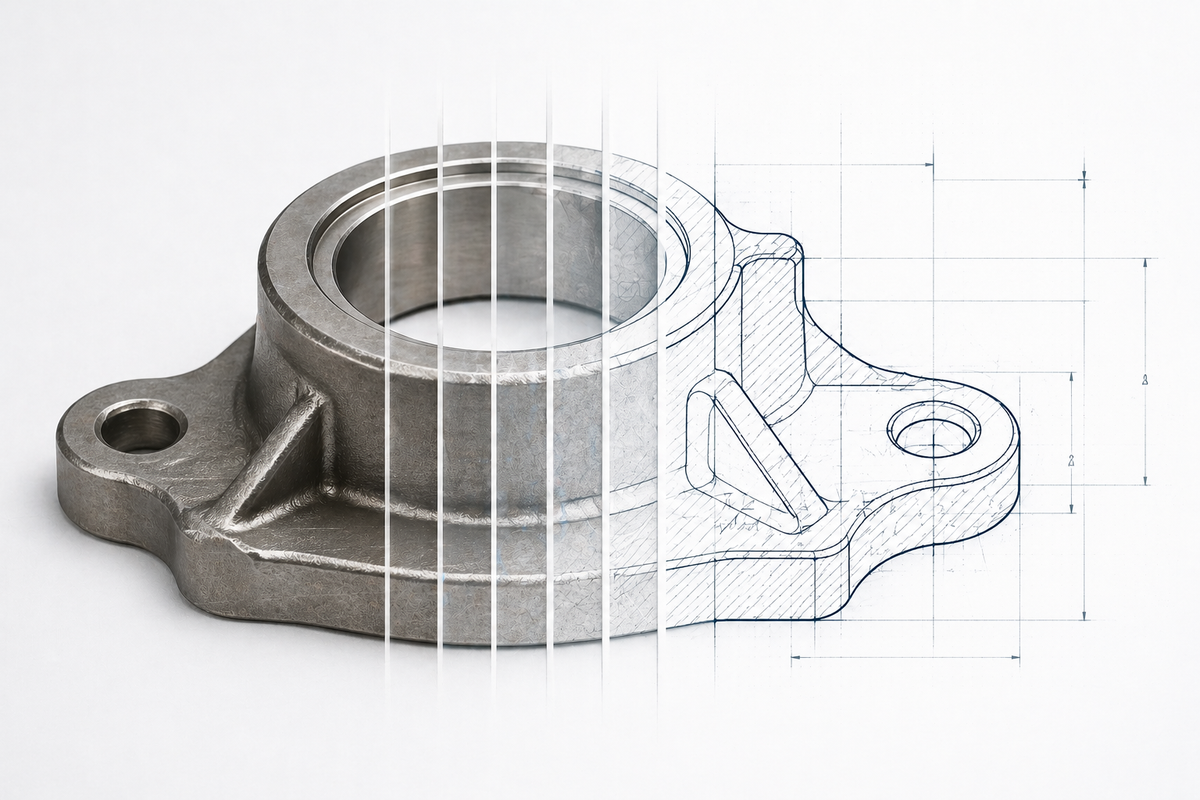
What is commonly called "digital inventory" today is, in many cases, nothing more than digital cataloging, while the real concept is far deeper and represents a fundamental transformation in supply chains. It's a concept not tied solely to spare parts; rather, in combination with "on-demand manufacturing" concept, it represents a radical shift in supply chains — from a model that relies on storage and forecasting to a more flexible model based on production at the point of need.
Have you come across this term before? "Digital Inventory"?
A term that was common originally in the Arab Gulf region and then spread globally, associated with the early rise of the idea of printing spare parts on demand. A new concept that has been gaining notable attention, especially when global supply chains come under pressure or disruption — as Google Trends data shows during the recent period since February 2026, and during earlier crises as well, most notably the COVID-19 crisis. It is as though crises are what remind the world of the need for alternatives more flexible than the traditional storage model.
But the question is: what does this term actually mean? Is it a digital catalog containing parts, their images, and their information? Is it a system for monitoring and tracking warehouses? Or something else?
In reality, the concept may not be equally clear to all parties, and through experience and practice, I found that this term is used in differently across different people and entities.
Therefore, it is useful to simplify the concept and set a more precise definition that can be agreed upon:
The idea of digital inventory relies on the concept of on-demand manufacturing — a manufacturing flexibility that was not available before the maturation of 3D printing. A single machine (or a limited set of machines) can produce an unlimited number of part types without the need for capital investment in molds and tooling, as is the case in technologies such as plastic injection molding or sand casting, or even in metal machining operations that require fixtures, cutting tools, and stock materials in specific dimensions for each product.
This shift does not merely change the way things are manufactured; it redefines the cost-and-risk calculations across the entire supply chain.
If on-demand manufacturing is available, why do we continue to manufacture parts in large quantities and store them? Why don't we produce what we need only when we need it?
From here, the concept of digital inventory emerged, based on replacing physical warehouses — with their operational costs, tied-up capital, and risks of obsolescence or damage — with a digital inventory that contains all the information necessary to reproduce the part on demand.
But does that mean having a 3D design of the part is enough to consider it part of a digital inventory?
The practical answer: no. Digital inventory goes far beyond that; in fact, most of what is called "Digital Inventory" today does not go beyond being digital archiving, and is not an actual inventory that can be relied upon.
Digital inventory can be viewed as maturity levels, starting from mere data and ending with an actual capability to fully replace traditional inventory. The following table illustrates these levels and what actually changes from one level to the next:
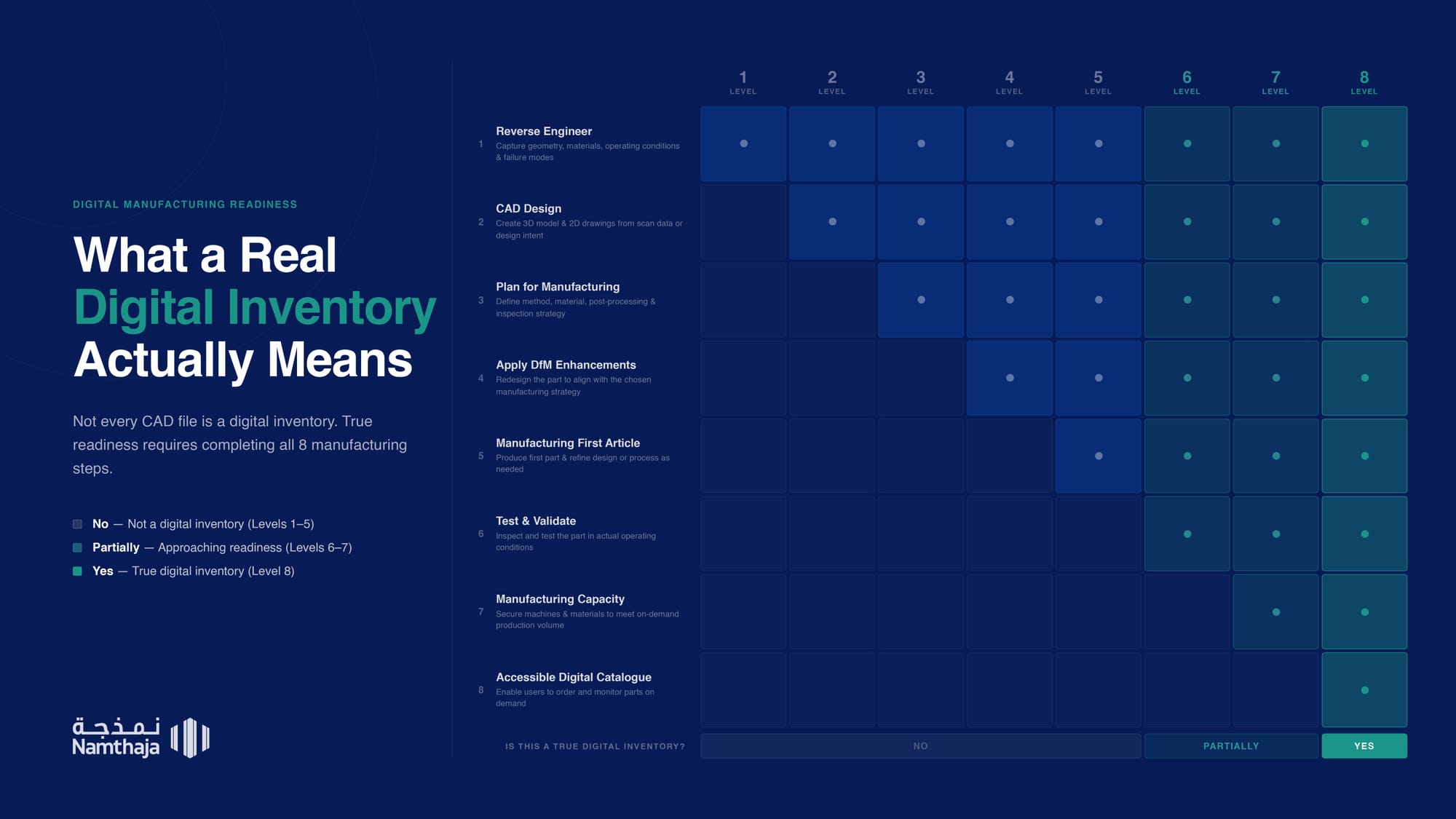
The table reveals that most of what is called digital inventory today does not go beyond the initial levels — levels that are not actually sufficient to replace physical inventory, since the part remains unproven in the field and not tied to a ready production capacity that can be relied upon. We cannot consider ourselves to have an actual digital inventory unless two main criteria are met (which represent the highest maturity levels in the table):
- The part must have undergone all the engineering processes required to manufacture it on demand, and must have actually been produced and proven successful in the field.
- There must be a production capacity ready to manufacture the part on demand, accessible and operable through a clear and easy-to-use digital platform.
This requires a sequence of steps, proactive planning, and cumulative work.
In light of this, digital inventory can be viewed not as a narrow technical solution, but as part of a broader transformation in the philosophy of supply chain management — from a model based on forecasting and storage to a model based on readiness and production on demand. With growing market volatility and supply disruptions, the importance of adopting this concept in the plans and practices of manufacturing and operational companies is increasing, along with taking gradual proactive steps toward building a digital inventory that supports their supply chains and the stability of their operations.
Written by Faisal Adnan Alamer, 18 Shawwal 1447 AH, 6 April 2026.